Leading hospital planning company in India
More than two decades of hospital planning & design experience.
“The more you sweat in hospital planning & design, less you bleed during hospital construction & execution”
Urvish Patel, Director, Medigence
Operational and Functional Chaos in hospital planning
What we often see is that a client, understandably eager to move forward, will bypass the foundational planning stages—like feasibility and functional programming—and want to jump straight into the architectural design.
The critical danger in doing this is that they are, in effect, designing a building based on assumptions rather than a well-defined operational and strategic blueprint.
This path almost invariably leads to the same outcome: a facility that is functionally compromised, financially inefficient, and an ongoing operational challenge to manage.
How we help clients with hospital planning ?
Hospital Location / Land feasibility
Best time to hire Medigence is before you finalize your land & location for your hospital green field project. Land comes with many constraints and hidden challenges, government restrictions, various regulatory norms, & location / zone based limitations. We help doctors and owners to analyze the land, scrutinize all the hidden challenges and limitations, and give them an idea of what on hand construction they will get in that land, how many tentative beds they can plan.
Hospital Building feasibility
Hospital Program Structure
Hospital Capacity & load planning
Hospital Campus Master Planning
Hospital Clinical service planning
Hospital Project Cost data for bankable project report
Hospital Blueprint & Conceptualization
Hospital Building Vertical Stacking
Hospital Project Cost analysis
Examples of work:
1200-Bed Multispeciality Hospital & Medical College: A comprehensive “End-to-end planning & design” project that also includes an auditorium, canteens, hostels, and a sports complex.
Medical Campus Near Gandhinagar (750 Beds): A large-scale campus project featuring a 750-bed hospital and medical college, for which we provided end-to-end planning and design services.
Rotary Medicity (450 Beds): A 15-acre “End-to-End Planning & Design” project that includes a 450-bed hospital, medical college, Ayurveda hospital, hostels, and staff quarters.
SMT Shardaben. R. Shah. Memorial Hospital (350+ Beds): An “End-to-end planning & design” plus turnkey project for a JCI/NABH compliant, 350+ bed multispeciality hospital.
Our Capabilities
Evidence-Based Functional Design (Planning "Inside-Out")
Architects often design from the “outside-in,” creating a beautiful building that simply doesn’t work for a hospital. We do the exact opposite. Before any design starts, we build the hospital’s operational “spine”—this is our Program Structure and Vertical Stacking process. We consolidate all requirements—your vision, clinical workflows, compliance, MEP needs, and patient flow—into a comprehensive blueprint. This blueprint dictates the final design, ensuring the building is built around your operational needs. This is the only way to avoid the functional chaos we so often see in facilities that were designed based on a floor plan instead of a functional plan.
Data-Driven Capacity & Load Planning
A crucial part of the planning process, which many doctors and owners forget, is calculating the true load the hospital will have to handle. Most planning is based on assumptions; ours is based on data. We go beyond simple bed counts to calculate the desired patient load for OPD, IPD, and OTs. We analyze the required energy load, heating and cooling loads, parking load, and even the load of patient relatives in various areas. Based on this hard Capacity & Load Analysis, we help you allocate sufficient and efficient space, preventing the crippling bottlenecks that crush a hospital’s profitability and reputation.
Frequently Asked Questions
1. What exactly does "hospital planning" cover beyond just the architecture?
Hospital planning is not only about drawings and layouts. True hospital planning focuses on how the facility actually functions day to day, how different departments interact with each other. It’s a combination of clinical workflow, medical equipment integration, and operational efficiency. If the flow isn’t right, even the best design won’t deliver results.
2. Why should we invest in a feasibility study before starting the project?
A hospital is one of the most capital-intensive investments and getting the fundamentals wrong can be costly. Feasibility study evaluates demand, competition, disease patterns, and financial viability. More importantly, it gives clarity on which specialties will drive revenue and which ones are essential for community care. It’s a practical roadmap that helps make informed decisions and protect your investment.
3. How do you manage medical equipment planning without overspending?
Medical equipment planning is often where budgets can spiral if not handled carefully. Buying too early can lead to outdated technology by the time the hospital is operational. Waiting too long can create structural or technical limitations.
We follow a staged approach. The hospital is designed to accommodate advanced equipment from the beginning, including all technical requirements. However, procurement is timed closer to project completion so you can invest in the latest technology, better pricing, and stronger service support.
4. Can we achieve NABH or JCI standards without significantly increasing costs?
Yes, but only if these standards are considered from the very beginning. When compliance is built into the initial design, it becomes part of the system rather than an afterthought.
Trying to upgrade an existing or partially built hospital to meet accreditation requirements often leads to expensive changes—like modifying corridor widths or relocating critical infrastructure.
5. We already have an architect. Why do we need a healthcare consultant?
Architects bring valuable expertise in design and structure, but hospital projects require a deep understanding of clinical operations as well who acts as the link between medical teams and the design team. We ensure that the spaces being created actually support real-world usage—whether it’s the placement of medical gas outlets, workflow efficiency in critical care units, or staff usability during long shifts.
This collaboration helps ensure that the final outcome is not just visually appealing, but also highly functional.
6. How do you future-proof a hospital in a rapidly evolving healthcare environment?
The key to future-proofing is flexibility.
We design hospitals with adaptable spaces that can evolve over time. This often involves planning “soft spaces” like administrative areas next to “hard clinical zones” such as imaging or operating theatres.
As needs change—whether due to technology upgrades or increased patient demand—these spaces can be repurposed without major disruption. The idea is to create a facility that works for today while remaining adaptable for the next 10–15 years.
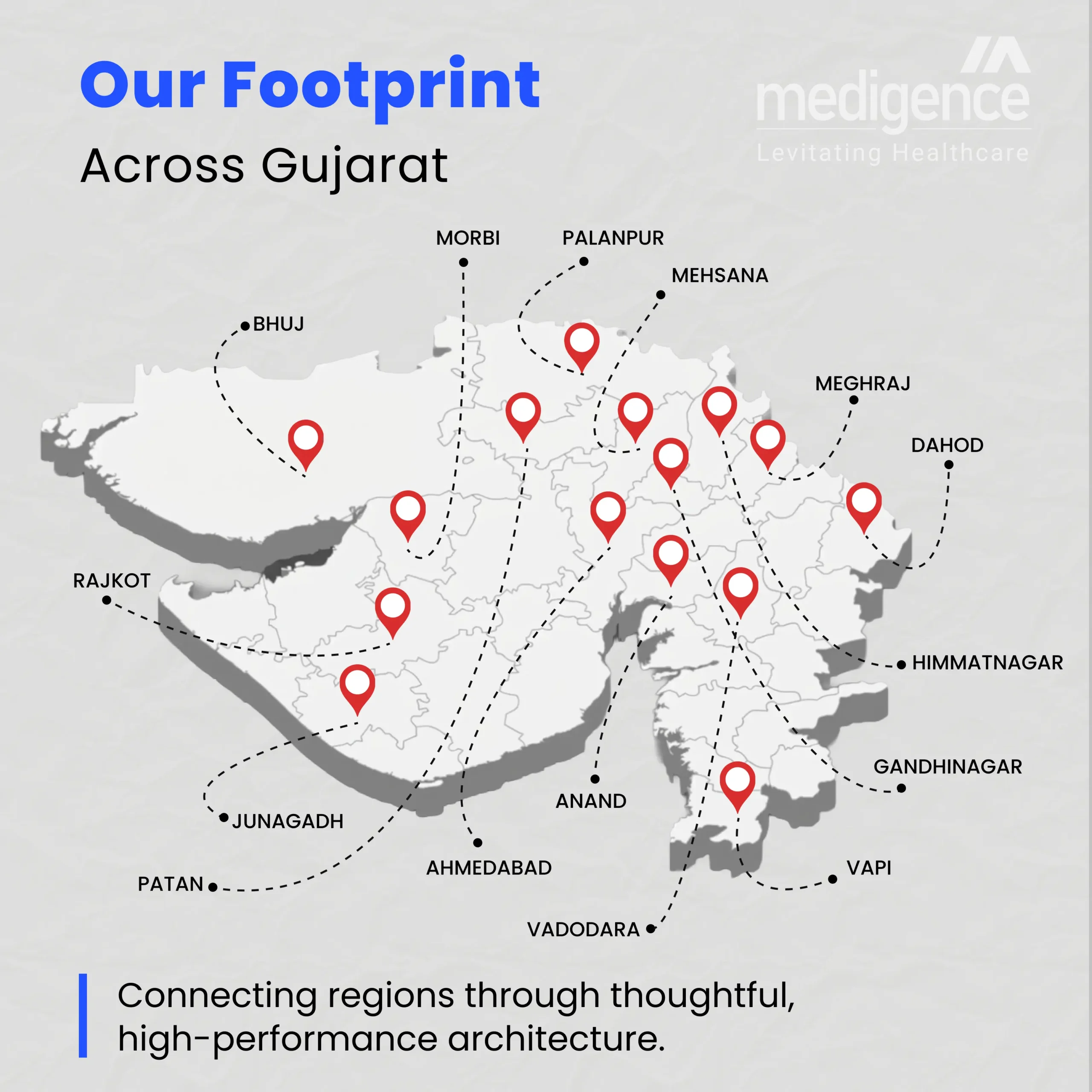
Serving Hospitals Across Major Cities — And Expanding Our Footprint
We proudly serve hospitals across multiple cities, delivering expert planning, design, and healthcare consulting services, with an expanding presence across India.